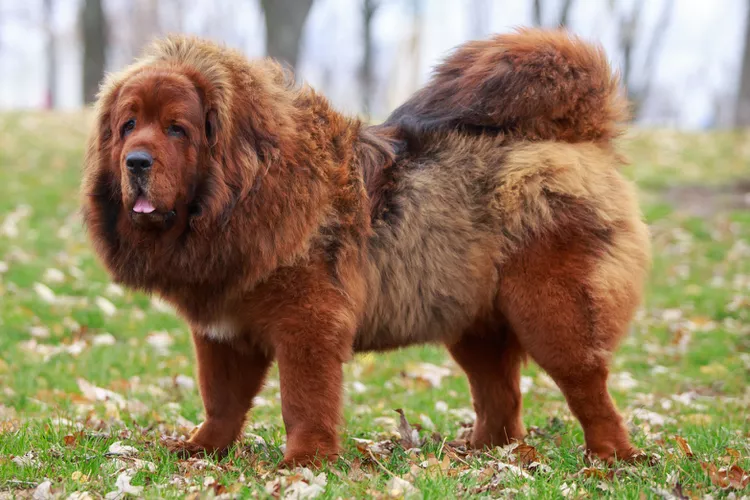
The Tibetan mastiff is a rare, large dog breed from Tibet with a massive, towering frame, flowing mane, and watchful expression. The breed is said to be as magnificent and alert as a lion. Used in Tibet and the Himalayas for thousands of years as powerful and imposing estate guardians, today’s Tibetan mastiff retains those protective instincts, watching over their home and family with endless tenacity.
Learn more about the watchful and powerful Tibetan mastiff and if they are the right dog to add to your home.
GROUP: Working
HEIGHT: Minimum 24 to 26 inches tall at the shoulder
WEIGHT: 70 to 150 pounds
COAT: Double outer coat is fine but hard, straight, and stand-off; undercoat is heavy, soft, and woolly
COAT COLOR: Black, brown/chocolate/liver, blue, gray, or gold/yellow
LIFE SPAN: 10 to 12 years
TEMPERAMENT: Intelligent, protective, strong-willed, tenacious, aloof
HYPOALLERGENIC: No
ORIGIN: Tibet
The Tibetan mastiff breed provides unparalleled loyalty, devotion, and protection to their family. As guardian dogs, they are wary of strangers and territorial of their families and their homes, according to the American Kennel Club (AKC). Because of their background as guardian dogs, they don't like to take direction from their families and can be difficult to train.
The breed’s guarding instincts are heightened at night, which can cause them to bark loudly and excessively in the evening hours. It’s best to keep your mastiff indoors at night to avoid bothering your neighbors. Make sure you have a secure fence to keep your dog from roaming day or night.
Due to the isolation of Tibet and a lack of written breeding records, the Tibetan mastiff’s history is shrouded in mystery, according to the AKC. We do know that the Tibetan mastiff is an ancient breed that has existed in Central Asia for thousands of years, and they are thought to be the origin of the different mastiff breeds.
The American Tibetan Mastiff Association says the Tibetan mastiff breed was first introduced outside of the Tibet region in 1847 when Queen Victoria received one as a gift. More than 100 years later, the breed finally made their way to the United States in the 1950s. The American Tibetan Mastiff Association, which is the national club for the breed in the U.S., was formed in 1974, and the breed received full recognition from the American Kennel Club in 2006.
The Tibetan mastiff requires special care and handling. Early socialization is mandatory with the Tibetan mastiff—an improperly socialized Tibetan mastiff has the potential to grow into a liability. Introduce your Tibetan mastiff puppy to as many people, places, animals, and things as possible, keeping interactions positive, and going at the dog’s pace.
Even with careful socialization, some Tibetan mastiffs find it difficult to accept strangers or strange animals, especially those entering the dog's property. Many Tibetan mastiffs, especially those that receive adequate socialization, are far more relaxed and accepting of strangers when off their own property.
As with all large and giant breeds, exercise for puppies and young adults must be approached with caution. Due to the Tibetan mastiff’s large frame and hefty weight, and predisposition to hereditary joint conditions like hip dysplasia, repetitive exercises like jogging or jumping should be limited and/or avoided completely until the dog is at least two years old and fully mature. Even a fully mature Tibetan mastiff is not going to be a jogging partner or agility champion, although most enjoy daily leisurely walks totaling between 30 to 60 minutes.
Even with all that fluff, Tibetan mastiffs are surprisingly easy to groom. Their coat sheds very little outside of one seasonal shed (typically in spring or summer) where they blow their coat, losing almost all of their undercoat in just a few weeks. During this heavy shed, frequent brushing and a bath or two can help but expect hair everywhere. The rest of the year, the coat sheds very little and requires just weekly brushing and bathing if they get dirty.
In addition to coat care and bathing, your dog needs regular tooth brushing and nail trimming.
Although Tibetan mastiffs are extremely intelligent and capable of quickly learning basic obedience skills, they can also be stubborn and not particularly inclined to always do what you ask. Training should be started at an early age and rules should be enforced consistently throughout the dog’s lifetime. Because the Tibetan mastiff is physically large and naturally suspicious of strangers, it is vital that any Tibetan mastiff owner be capable of physically restraining their dog when necessary, whether in public or at home.
Even with intensive socialization (which is an absolute must with this breed), the Tibetan mastiff can be difficult to train. Massive and powerful, the breed’s protective instincts are so heightened that some Tibetan mastiffs may not always listen when their owners say a visitor is allowed and not an intruder to be vanquished. Because of this, Tibetan mastiffs should only be owned by experienced dog owners.
The Tibetan mastiff, like many purebred dogs, is prone to certain genetic conditions. Responsible breeders test their adult dogs prior to breeding them to avoid passing on inherited diseases. The American Tibetan Mastiff Association requires (or recommends depending on the condition) all member breeders to perform certain health tests on all dogs prior to breeding them, as listed below.
Feeding your Tibetan mastiff may prove tricky. Despite their enormous size, many Tibetan mastiffs don’t have huge appetites, and eat far less than you might assume. Some Tibetan mastiffs even go on food strikes, refusing to eat for days at a time. For these reasons, it’s especially important to feed your pup high-quality dog food (consult with your breeder or veterinarian for a recommendation).
Pay attention to how much your Tibetan mastiff is eating so you know how much your dog is consuming and whether they're on a food strike. If your Tibetan mastiff happens to have a healthy appetite, avoid overfeeding. Free feeding can lead to weight gain, which puts stress on the joints and can contribute to health issues. Feeding measured meals allows you to track how much your Tibetan mastiff is eating, whether it’s too much, too little, or just right.
The Tibetan mastiff is one that requires an experienced dog owner. Anyone considering a Tibetan mastiff should reach out to a reputable breeder to talk about what’s it’s like to live with the breed. Some adult Tibetan mastiffs might find themselves in rescue on occasion. More often though, anyone searching for a Tibetan mastiff will need to track down a reputable breeder and get on a waitlist (often a long waitlist) for a puppy. Expect to pay between $1,500 to $5,000 for a purebred Tibetan mastiff.
Here are a few helpful resources to start your search:
Although Tibetan mastiffs are incredibly loyal and protective family dogs, they are only a fit for certain families. Before bringing one of these working dogs home, review the pros and cons of Tibetan mastiffs:
The Tibetan mastiff breed is rare and a challenge to train. But if you appreciate this dog, you might also like these breeds:
Otherwise, there’s a whole world of potential dog breeds out there—with a little research, you can find the right one to bring home.
The Tibetan mastiff is not well-suited for first-time dog owners or those who are new to guardian breeds. This breed is difficult to train and socialize, which requires someone who knows how to provide the right training and socialization opportunities to set these dogs up for success.
Tibetan mastiffs are devoted to their owners, and usually get along well with children who are part of the family, although (as with all dogs) the kids must be taught to respect the dog. The breed is not always good with children they don't know, especially those that run around and scream, or attempt to bother the dog. All interactions between Tibetan mastiffs and children must always be supervised by a responsible adult.
Male Tibetan mastiffs may go on food "strikes" during mating season. When females are in season, males will often refuse to eat for a week or more and can lose a percentage of their body weight. However, both males and females only eat when they are hungry, so it is not uncommon for a Tibetan mastiff to skip a meal altogether even when it's not mating season.
The Tibetan mastiff is legal in most places in the United States, but some specific cities have banned the dog. Bans on dogs frequently change, so before taking home or traveling with a dog, find out if there is any breed-specific legislation that could affect you.

Swollen Lymph Nodes in Dogs
Dogs' lymph node glands may become enlarged due to infection or disease. Learn the causes, treatment, and prevention.
What Is Spaying? All About the Procedure in Dogs
What is a spay? Should you have your dog spayed? Learn what it means to spay a dog, a procedure also known as an ovariohysterectomy.
Can Dogs Eat Popsicles?
You might be wondering can dogs eat popsicles? Certain types of frozen treats are safe for your dog, but you need to be aware of ingredients and allergies
Can Dogs Drink Milk?
Dogs can have milk, providing they are not lactose intolerant. It should really only be given in small quantities though
Can My Dog Eat Tomatoes?
You'll want to keep Fido out of your garden since the tomato plant is toxic, but you can safely offer him ripe tomatoes as a nutrient-packed treat.
Can Dogs Taste Spicy Flavors?
While dogs and humans experience some flavors differently, dogs do taste spicy flavors and in some cases, this can be harmful for them.
Should You Allow Your Indoor Cat to Go Outside?
Here are pros, cons, and safety considerations for allowing indoor cats to explore outdoors and the indoor vs outdoor cats debate, plus safety tips.
Can My Spayed Cat Still Be in Heat?
If your cat was spayed but appears to be in heat, the condition may be caused by several factors. Learn about them here.
How to Keep Cats Cool in Summer
Summertime means heat and with increased temperatures, you have an increased risk of heatstroke in cats. Find out how to prevent heatstroke and keep your cat cool in the summer.
Taurine for Cats
Taurine is an essential animal protein in your cat's diet. Learn more about the various ways it supports your feline's body.
Why Is My Cat Always Hungry and Meowing?
A cat can act like it is always hungry, and there may be a medical reason for this. Learn what behavior is normal and when to see your veterinarian.
Elf Cat: Breed Profile, Characteristics & Care
Elf cats are a new, rare cross between a sphynx and American curl with curly ears and a playful personality.
Maine Coon Cat: Breed Profile, Characteristics & Care
The Maine Coon cat is of the largest cat breeds in the world. These amiable, gentle cats make great companions. Learn about the Maine Coon cat breed's appearance, temperament, health, and care needs.
Calico Cat: Breed Profile, Characteristics & Care
Calico cats boast unique tri-color coats, and they are famous for being both spunky and sweet. Learn about the calico cat color pattern.
Bombay: Cat Breed Profile, Characteristics & Care
The Bombay cat, a mix of the Burmese and the American shorthair, features an all-black coat, a stocky build, and a friendly demeanor.
Barbet: Dog Breed Characteristics & Care
Learn about the barbet dog, a French hunting breed that's tough to find in the United States. It's known for its curly coat and calm demeanor.
Bichon Frise: Dog Breed Characteristics & Care
The bichon frise is a fluffy little white dog with a joyful personality. Learn more about its appearance, personality, history, care, and more.
Australian Kelpie: Dog Breed Characteristics & Care
The Australian kelpie is an intelligent, high-energy dog breed developed for herding. Learn about the Australian kelpie, including temperament, appearance, history, and care needs.
How to Teach Your Dog to Play Dead in 4 Steps
Playing dead is a fun dog trick that most dogs can pick up pretty quickly. Learn simple steps to teach your dog to play dead when you say "bang."
Different Meanings of a Dog's Wagging Tail
A dog wagging his tail is a common sight, but it may mean more than you think. Find out why dogs wag their tails and what canine tail wagging means.


