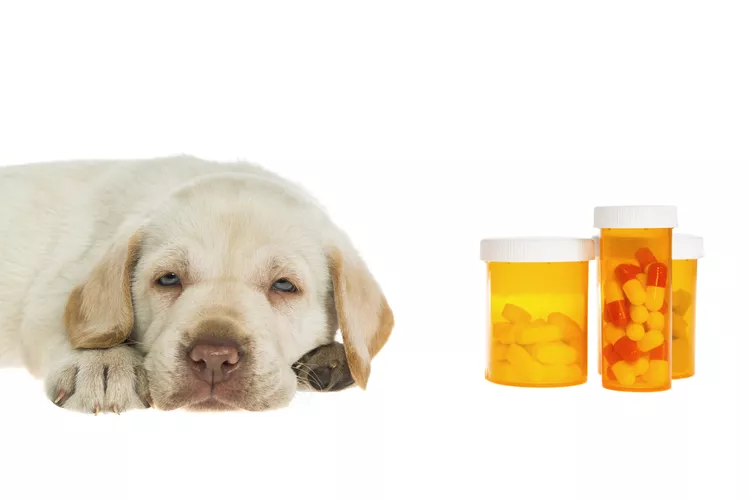
Whether your dog is getting older or they play a little too hard and tweak something, it's difficult to watch them limp along while you wait to bring them in to the vet. You may be tempted to give them something from your own medicine cabinet to help with the pain. You should be wary about giving your dog ibuprofen, though.
Ibuprofen, which is the generic drug name for products such as Advil, Nuprin, and Motrin, belongs to a class of drugs called Non-Steroidal Anti-Inflammatory Drugs, or NSAIDs. The inflammation process is complex and within it, an enzyme called cyclooxygenase, or COX, produces prostaglandins, which may then cause inflammation. NSAIDs work to inhibit COX, thereby diminishing the production of the prostaglandins that cause inflammation. The problem arises in the fact there are two different COX enzymes, COX-1 and COX-2, and ibuprofen blocks both indiscriminately. While COX-2 produces the inflammatory prostaglandins, COX-1 works to maintain normal gastric lining, blood flow to the kidneys, and even platelet clumping.
So ibuprofen not only works to decrease inflammation by blocking COX-2, it can also reduce the protective mucous that lines the stomach, blood flow to the kidneys, and even can increase clotting time.
While ibuprofen is relatively safe for you to take, there is an incredibly narrow margin of safety in dogs. This means the amount a dog would need to be therapeutic is not that far from the amount that would be toxic. In fact, the toxic dose of ibuprofen is only about 1.5 times the effective dose if used chronically. There are veterinary specific NSAIDs that have a much wider therapeutic range and are, thus, much safer for your dog. This includes medications such as Carprofen (Rimadyl, Novox), Meloxicam (Metacam), Deracoxib (Deramaxx), and Grapiprant (Galliprant).
Even if you have other NSAIDs at home besides ibuprofen, it's still a good idea to wait to be seen by the vet before giving your dog anything. Switching from one NSAID to another requires something called a washout period. If you give your dog an NSAID from home to get them through to their appointment, your vet won't be able to start them on a veterinary NSAID for a few days. Washout periods can vary, but generally your vet will want to wait to start a new NSAID until 5-7 days after their last dose of medication at home. This period may be longer if your dog is having symptoms such as vomiting or diarrhea.
Dogs that ingest ibuprofen can break with vomiting (with or without blood in it), diarrhea, dark and tarry stools (called melena, this can be indicative of bleeding in your dog's gastrointestinal tract), lethargy, a decreased appetite, abdominal pain, pale or even yellow gums, an increase or a decrease in both drinking and urination, tremors, seizures, coma, and even death. Symptoms can be seen anywhere from two to six hours after ingestion. More severe symptoms may not appear until a few days after ingestion.
In an acute ingestion, the toxic dose of ibuprofen is considered to be 11 mg per pound. As mentioned earlier, it can be as low as 3 – 4 mg per pound if given chronically.
The first level of toxicity is considered to be gastrointestinal. This is where the inhibition of the mucosal lining of your dog's stomach comes into play. The mucus within your dog's stomach acts to protect the lining from the incredibly acidic environment of the stomach contents. With less mucus to protect it, the lining can develop ulcerations that can start to bleed. This can cause both vomiting of blood as well as melena. If allowed to progress unchecked, an ulcer can even completely rupture the stomach lining, which is a life-threatening emergency in and of itself.
The next level of ibuprofen toxicity is related to your dog's kidney function and can occur at slightly higher dosages than the first level. Remember that some prostaglandins work to promote blood flow to the kidneys. As this blood flow decreases, toxins that would normally be filtered out by the kidneys builds up. This can damage the kidneys and this damage can be temporary or permanent, depending on how quickly medical intervention is initiated and how healthy the kidneys were before they were damaged.
The final level of ibuprofen toxicity is related to your dog's nervous system. At very high doses, ibuprofen can cause tremors and seizures in dogs. It can even put your dog into a coma!
If you realize your dog has gotten into your stash of ibuprofen, you should seek veterinary help as soon as possible. Not only can your vet induce vomiting if it's been only and hour or so since your dog got into the medication, but your dog's prognosis is much better if medical intervention is sought earlier rather than later. Don't wait for your dog to become symptomatic. Avoid giving your dog anything at home, such as Pepto-Bismol or Kaopectate; some of the formulations may contain salicylates, which can interact with the ibuprofen and cause further damage.
Treatment will be based on how much ibuprofen your dog got into. Some cases may require hospitalization for intravenous fluids to support blood flow to the stomach and kidneys, medications to protect your dog's stomach, and frequent kidney function blood tests to ensure your dog is responding to treatment. Severe cases may require muscle relaxers to prevent tremors/seizure activity and blood transfusions to replenish not only the blood lost from a dog's GI ulcers, but to also replenish clotting factors to help the ulcers stop bleeding.
When it comes to NSAIDs for dogs, there are definitely varieties that are much safer than ibuprofen. It's always best to keep your medication out of reach of your dog and to always check with your vet before giving them your own medication.

Swollen Lymph Nodes in Dogs
Dogs' lymph node glands may become enlarged due to infection or disease. Learn the causes, treatment, and prevention.
What Is Spaying? All About the Procedure in Dogs
What is a spay? Should you have your dog spayed? Learn what it means to spay a dog, a procedure also known as an ovariohysterectomy.
Can Dogs Eat Popsicles?
You might be wondering can dogs eat popsicles? Certain types of frozen treats are safe for your dog, but you need to be aware of ingredients and allergies
Can Dogs Drink Milk?
Dogs can have milk, providing they are not lactose intolerant. It should really only be given in small quantities though
Can My Dog Eat Tomatoes?
You'll want to keep Fido out of your garden since the tomato plant is toxic, but you can safely offer him ripe tomatoes as a nutrient-packed treat.
Can Dogs Taste Spicy Flavors?
While dogs and humans experience some flavors differently, dogs do taste spicy flavors and in some cases, this can be harmful for them.
Should You Allow Your Indoor Cat to Go Outside?
Here are pros, cons, and safety considerations for allowing indoor cats to explore outdoors and the indoor vs outdoor cats debate, plus safety tips.
Can My Spayed Cat Still Be in Heat?
If your cat was spayed but appears to be in heat, the condition may be caused by several factors. Learn about them here.
How to Keep Cats Cool in Summer
Summertime means heat and with increased temperatures, you have an increased risk of heatstroke in cats. Find out how to prevent heatstroke and keep your cat cool in the summer.
Taurine for Cats
Taurine is an essential animal protein in your cat's diet. Learn more about the various ways it supports your feline's body.
Why Is My Cat Always Hungry and Meowing?
A cat can act like it is always hungry, and there may be a medical reason for this. Learn what behavior is normal and when to see your veterinarian.
Elf Cat: Breed Profile, Characteristics & Care
Elf cats are a new, rare cross between a sphynx and American curl with curly ears and a playful personality.
Maine Coon Cat: Breed Profile, Characteristics & Care
The Maine Coon cat is of the largest cat breeds in the world. These amiable, gentle cats make great companions. Learn about the Maine Coon cat breed's appearance, temperament, health, and care needs.
Calico Cat: Breed Profile, Characteristics & Care
Calico cats boast unique tri-color coats, and they are famous for being both spunky and sweet. Learn about the calico cat color pattern.
Bombay: Cat Breed Profile, Characteristics & Care
The Bombay cat, a mix of the Burmese and the American shorthair, features an all-black coat, a stocky build, and a friendly demeanor.
Barbet: Dog Breed Characteristics & Care
Learn about the barbet dog, a French hunting breed that's tough to find in the United States. It's known for its curly coat and calm demeanor.
Bichon Frise: Dog Breed Characteristics & Care
The bichon frise is a fluffy little white dog with a joyful personality. Learn more about its appearance, personality, history, care, and more.
Australian Kelpie: Dog Breed Characteristics & Care
The Australian kelpie is an intelligent, high-energy dog breed developed for herding. Learn about the Australian kelpie, including temperament, appearance, history, and care needs.
How to Teach Your Dog to Play Dead in 4 Steps
Playing dead is a fun dog trick that most dogs can pick up pretty quickly. Learn simple steps to teach your dog to play dead when you say "bang."
Different Meanings of a Dog's Wagging Tail
A dog wagging his tail is a common sight, but it may mean more than you think. Find out why dogs wag their tails and what canine tail wagging means.


