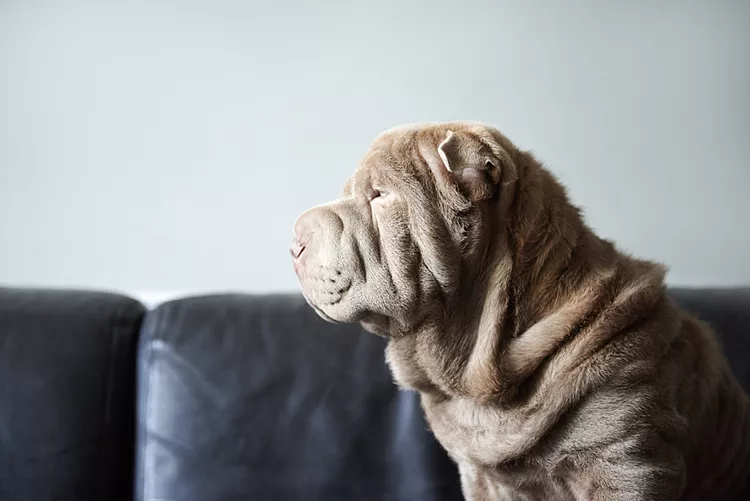
- 01 of 11
Tilting Their Heads
Most people have seen dogs tilt their heads to the side as if questioning something. It commonly happens when dogs hear a new sound or see something they don't quite understand. Head tilting is especially common in puppies. This behavior can have a few different meanings.
A dog might cock her head to the side to get in a better position to hear or see something. Consider that a dog's muzzle can obstruct vision. Perhaps the ear flaps muffle some sounds. Momentarily tilting the head might be a way to see or hear better. There is also some evidence that this is a sign of concentration and reasoning.
If a dog's head remains in the tilted position and the dog seems to have no control over it, this can be a sign of a health problem, such as an ear infection or even a problem in the brain. See your vet as soon as possible if your dog has a suspicious head tilt.
- 02 of 11
Eating Poop
It's one of the grossest things a dog can do. Poop-eating, also called coprophagia, is a common habit among dogs. We may never fully understand why so many dogs eat feces. Theories abound, including poop-eating being an instinct, a sign of illness or malnutrition, the effect of anxiety and stress, or a form of pica (the compulsion to eat non-food items).
Coprophagia in dogs may be learned at a young age or even brought on by senility. While this habit is generally not highly dangerous to dogs, it's quite disgusting and can cause certain illnesses. It is important to have your dog examined by your vet if it is eating feces to rule out underlying medical problems. If no medical concerns are found, specific training may help you break this habit in some cases.
- 03 of 11
Chasing Their Tails
Does your dog spin in circles chasing his tail? This is a common behavior in dogs. In some cases, tail-chasing is a natural, playful activity. However, excessive tail chasing can be a sign of a health or behavior problem.
If your dog is chewing at his tail when he catches it, then he might have a problem with his skin or anal glands. If the tail chasing is constant and intense, this may be a sign of an obsessive-compulsive disorder. Yes, OCD affects dogs, though this is not especially common. Talk to your veterinarian if you are concerned about your dog's tail-chasing or if your dog is causing self-injury to its tail.
- 04 of 11
Barking, Howling, or Baying
Vocalization, especially barking, is normal behavior in dogs. Some dogs vocalize more than others and for different reasons. Dogs may bark to communicate with humans and to express themselves. They may even bark, bay, or howl to communicate with other dogs.
Barking is common when a dog senses danger. Howling often occurs when dogs hear other dogs howl or even similar noises like sirens. In general, this is a natural, instinctive behavior in dogs. Sometimes a dog's breed will determine vocalization type (many hounds bay or howl, little dogs tend to yip; Basenjis generally cannot bark, etc.)
Excessive vocalization can be a sign of distress or boredom. Don't ignore this type of barking. It could lead to barking as a behavior problem. However, you also do not want to reinforce the vocalization when it is excessive. Training can help with vocalization issues though you may need the help of a dog trainer when vocalization is a major problem.
Continue to 5 of 11 below - 05 of 11
Scooting Their Butts
It's a funny thing to watch when a dog scoots his butt on the ground. If you not sure, you've seen this, or want a laugh, check out this funny video of dogs scooting. Is this something your dog does? Don't worry; your dog is not weird (well maybe he is, but it's not because of scooting).
Dogs scoot their butts on the ground because something is bothering them back there. That "something" is usually the anal glands. Located on either side of the anus, these sacs fill with oily, stinky fluid. In most dogs, the anal glands naturally empty during bowel movements. Other dogs need a little help from humans to have their anal glands expressed occasionally, so this should be assessed by your veterinarian if you are noticing frequent scooting.
Other reasons for scooting include skin problems, anal masses or, your dog might have something stuck back there (okay, usually that's poop) and is just trying to remove it.
- 06 of 11
Licking People
It's extremely common for dogs to lick people. Why do they do this? As you might have guessed, licking is usually a way for dogs to show us affection. That explains why we often call them "doggie kisses."
Dogs also lick us because they are seeking our attention. Plus, they think we taste pretty good. There are instinctive reasons for licking as well; wolves and wild dogs sometimes feed their young by regurgitating food from the hunt.
If it bothers you when your dog licks you, then training is the best way to stop it. Generally, ignoring the licking and rewarding when your dog stops licking will train your dog that licking is not desired. If you don't mind licking, then it's probably okay. Although dogs mouths are not cleaner than ours (that's a myth), the bacteria are not generally harmful unless it gets into an open wound.
- 07 of 11
Humping
Does your dog like to hump other dogs? Objects? People? Humping behavior is quite natural in dogs. Contrary to what you might think, humping is not always sexual. It's also not related to dominance as some people used to think.
Dogs usually hump each other as a part of normal play. They may also playfully hump objects and people. Excitement (non-sexual) and attention-seeking may also be reasons for humping. Humping between altered dogs is not generally a problem unless it bothers one of the dogs. If you sense a problem when two dogs are playing, separate the dogs immediately. For intact or unaltered dogs, this can quickly lead to mating and pregnancy so intact dogs should not be left together unless that is the desired outcome.
Humping of objects is only a problem if it bothers you, or if it is done excessively as this can lead to injuries to the dog's genitals and/or groin area. When it comes to humping people, you will probably want to break this habit for your houseguests' sake. Often, the solution is walking away from the dog and denying attention until humping stops, or redirecting them to a better alternative such as playing with a favorite toy.
- 08 of 11
Sniffing Other Dogs' Butts
Two dogs meet, and suddenly they are sniffing each other in the rear end. Why do they do this? Thanks to a highly complex and superior olfactory system, dogs smell at least 10,000 times better than humans.
Dogs learn about the world through their noses. Mutual sniffing among dogs is a normal way for them to learn about each other. Many of the most concentrated scents are in the area of the anus and genitals. A dog can learn about gender, reproductive status, temperament, diet, and much more just from sniffing another dog's rear end.
Each being (dogs, humans, etc.) has his or her unique scent. This might be why some dogs take to sniffing humans in embarrassing ways. If your dog is getting a little too personal with people, redirect him to something else, like a treat or toy.
There's no reason you should keep two dogs from sniffing each other unless one dog seems bothered by it. Two dogs may get along better if you allow each to sufficiently sniff the other.
Continue to 9 of 11 below - 09 of 11
Digging
Many owners get frustrated when their dogs keep digging up the yard. Dogs usually dig because they are bored or anxious. Some dogs dig to hide their toys from other dogs (or perceived threats to their possessions). Dogs may also dig when it is hot out (to find a cooler spot underground to lie down in). If this is the case, then your dog is probably too hot to be outdoors.
The best way to prevent digging is to refrain from leaving your dog outside alone. Try interacting more with your dog by providing exercise or playing games.
- 10 of 11
Leaning on People
Is your dog a leaner? Many dogs love to lean on their owners' legs, feet or bodies. This seems especially common in giant dog breeds.
The general reason for this is simple: your dog wants to be closer to you. Dogs are affectionate creatures. Don't let anyone tell you that your dog is trying to dominate you in some way, because that is simply untrue.
Less commonly, leaning may be a sign of fear or insecurity. Leaning may also be related to separation anxiety, in which case your dog will show other signs of anxiety when you leave him alone.
- 11 of 11
Panting
Panting is a completely normal canine behavior. But what is the reason for panting? Dogs pant primarily to cool themselves off. Because they do not sweat the way humans do, dogs must rely on the exchange of air at their mouths to cool their bodies off. Since this is a very inefficient process, we humans should do our best to keep our dogs cool, preventing heat exhaustion and heatstroke.
Some dogs pant due to anxiety, stress or fear. Removing your dog from the stressful situation is the best action you can take. Panting may also be a sign of illness or injury in dogs. If your dog's panting seems to be a problem, be sure to contact your vet right away.