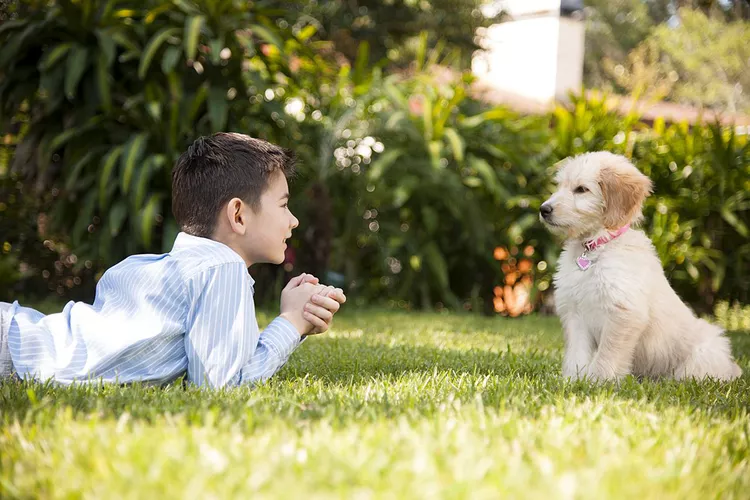
Dogs are social creatures that live together, and so they need a dog language in order to get along. How dogs communicate with one another is based on a system of common signals. Obviously, dogs can't talk, so their "language" is comprised of other signals—primarily body language, such as movement and positioning of the ears and tail, as well as how a dog positions himself near other dogs.
Your dog's ancestors survived by forming packs that hunted together, communally protected young, and defended territory from outsiders. And while two individuals can get along, the more individuals added to a group increase the chance of arguments. Constant fights and injuries weaken the group. Survival depends on every dog—and puppy—in the group staying healthy and productive.
Dog language not only allows dogs to communicate and understand each other. It also is a system used for conflict resolution, including calming signals that head off fights. In fact, once you understand how dogs communicate and the way they interpret your verbal and silent body language, you can better communicate with your puppy.
Canine communication is a complex system of body language, vocalization, and even scent cues. These signals reinforce the dog's social position within the group.
Dogs are pretty flexible with members of their family group. That’s why it’s so important to socialize your puppy early and continue throughout his or her life. Your dog considers you—and other people and pets in the household—to be a part of his family group, and acts accordingly.
Many behavior problems arise from normal dog behaviors such as chewing, barking, and more. Oftentimes, though we think we are being clear by directing and vocalizing to our pets: we are actually are not communicating in a way that our dog can understand. Even though your communication to your pet seems obvious to you, it is often as if trying to understand a foreign language to a dog. They can only interpret the best way they know-how.
If your relationship is to reach its full potential, it is important that you understand how your dog communicates so that you can be more effective at teaching him. Don’t expect puppies (or adult dogs for that matter) to automatically understand and read your mind. Puppies make behavior mistakes because they don’t know any better and more often than not it's a communication failure on our side! Participating in puppy training classes and working with certified dog trainers from an early age can be very helpful.
Compared to your puppy, humans are hearing-deaf and scent-blind. That makes it impossible for us to understand some of the more subtle signals of the canine language. But by paying close attention to body language and apparent vocal cues that our pets give us, we can learn to interpret the more obvious canine signals.
Dogs evolved with the ability and fascination of paying close attention to the humans they love. So your puppy will meet you halfway, given a chance, and learn a large human vocabulary, particularly when words and tone and training efforts are used with consistency.
Dogs use body language, vocalizations, and scent alone or in combination. Each type of communication has advantages and disadvantages.
Body language is one of the main ways that pets communicate and it can be so subtle that even an experienced dog owner can miss cues from time to time. Being aware of the eye, ear, tail, and body movement and positioning and the various meanings are very important for understanding your pet.
Though it seems subtle, body language is one of the few ways dogs have of communicating with us! Dogs have spent centuries trying to understand humans so as to please them. We could do a lot more to try to understand them. The more time you spend with your pet socializing, going for walks, working with certified trainer's and purposely paying attention to their body language, the better you will get. The best dog owners are consistent with this.
Sound carries over long distances. Howls, barks, yips, snarls, and growls are more easily understood amongst dogs. However, a bark may alert adversaries as well as pack members, so it’s not effective for stealth communication. Barks can communicate a lot of different messages such as excitement, fear, need for food or water, and more.
Scent signals don’t require the dog’s presence to get a message across. The scent of urination can be left behind to alert other dogs of their presence. Anal gland scents can be left when a dog defecates which is normal or in instances when a dog is extremely nervous or fearful, anal glands may be expressed leaving a lingering odor.
Dogs use combinations of each technique to communicate meaning. Very basically, canine communication is used to either decrease the distance between individuals with signals that ask for attention—a wagging puppy tail, for example—or to increase the distance between individuals with warning signals such as growls.

Swollen Lymph Nodes in Dogs
Dogs' lymph node glands may become enlarged due to infection or disease. Learn the causes, treatment, and prevention.
What Is Spaying? All About the Procedure in Dogs
What is a spay? Should you have your dog spayed? Learn what it means to spay a dog, a procedure also known as an ovariohysterectomy.
Can Dogs Eat Popsicles?
You might be wondering can dogs eat popsicles? Certain types of frozen treats are safe for your dog, but you need to be aware of ingredients and allergies
Can Dogs Drink Milk?
Dogs can have milk, providing they are not lactose intolerant. It should really only be given in small quantities though
Can My Dog Eat Tomatoes?
You'll want to keep Fido out of your garden since the tomato plant is toxic, but you can safely offer him ripe tomatoes as a nutrient-packed treat.
Can Dogs Taste Spicy Flavors?
While dogs and humans experience some flavors differently, dogs do taste spicy flavors and in some cases, this can be harmful for them.
Should You Allow Your Indoor Cat to Go Outside?
Here are pros, cons, and safety considerations for allowing indoor cats to explore outdoors and the indoor vs outdoor cats debate, plus safety tips.
Can My Spayed Cat Still Be in Heat?
If your cat was spayed but appears to be in heat, the condition may be caused by several factors. Learn about them here.
How to Keep Cats Cool in Summer
Summertime means heat and with increased temperatures, you have an increased risk of heatstroke in cats. Find out how to prevent heatstroke and keep your cat cool in the summer.
Taurine for Cats
Taurine is an essential animal protein in your cat's diet. Learn more about the various ways it supports your feline's body.
Why Is My Cat Always Hungry and Meowing?
A cat can act like it is always hungry, and there may be a medical reason for this. Learn what behavior is normal and when to see your veterinarian.
Elf Cat: Breed Profile, Characteristics & Care
Elf cats are a new, rare cross between a sphynx and American curl with curly ears and a playful personality.
Maine Coon Cat: Breed Profile, Characteristics & Care
The Maine Coon cat is of the largest cat breeds in the world. These amiable, gentle cats make great companions. Learn about the Maine Coon cat breed's appearance, temperament, health, and care needs.
Calico Cat: Breed Profile, Characteristics & Care
Calico cats boast unique tri-color coats, and they are famous for being both spunky and sweet. Learn about the calico cat color pattern.
Bombay: Cat Breed Profile, Characteristics & Care
The Bombay cat, a mix of the Burmese and the American shorthair, features an all-black coat, a stocky build, and a friendly demeanor.
Barbet: Dog Breed Characteristics & Care
Learn about the barbet dog, a French hunting breed that's tough to find in the United States. It's known for its curly coat and calm demeanor.
Bichon Frise: Dog Breed Characteristics & Care
The bichon frise is a fluffy little white dog with a joyful personality. Learn more about its appearance, personality, history, care, and more.
Australian Kelpie: Dog Breed Characteristics & Care
The Australian kelpie is an intelligent, high-energy dog breed developed for herding. Learn about the Australian kelpie, including temperament, appearance, history, and care needs.
How to Teach Your Dog to Play Dead in 4 Steps
Playing dead is a fun dog trick that most dogs can pick up pretty quickly. Learn simple steps to teach your dog to play dead when you say "bang."
Different Meanings of a Dog's Wagging Tail
A dog wagging his tail is a common sight, but it may mean more than you think. Find out why dogs wag their tails and what canine tail wagging means.


